Keeping a Small First-Aid Kit Dry During a Day Outdoors
Your small first aid kit is easy to throw in a corner of your backpack and then quickly forgotten. Wet gloves, dripping wet boots, cold and damp gear in your backpack can cause your dressings to become soggy messes within a few hours. A simple branch to brush against while walking back to your truck can bring about a cut to your finger within minutes. And when that happens your small first aid kit in your side pocket could well be wet within. Thus keeping your supplies dry is not about buying the biggest dry storage container. Rather it involves a number of strategies for using layers, selecting locations, and developing habits to deal with the day's events as they unfold.
Start with the contents, not the pouch
First look at what supplies you will be needing to keep dry in the first aid kit. There are many supplies that will need to be kept sealed in order to be used as wound care. These supplies include: bandages, gauze, rolled gauze, medical tape, wipes, antiseptic cream, etc. Also any medications or special supplies (such as epinephrine, etc) will need to be kept in separate bags and checked to make sure they are still useable and to follow any special storage instructions. Also make sure to keep any original labels and packaging with any directions and or warnings for that supply. Also it is wise to check your supplies at the change of seasons or prior to a long trip.
A small first-aid kit contains basic items to treat minor problems. The contents can be increased as needed for longer trips or for activities such as hunting, hiking or building habitats. All items should still be easily accessible in the container. In addition to a dry storage space, it is also important to have current first-aid knowledge and to be well-prepared for the expected activities.
Use two barriers against wet weather
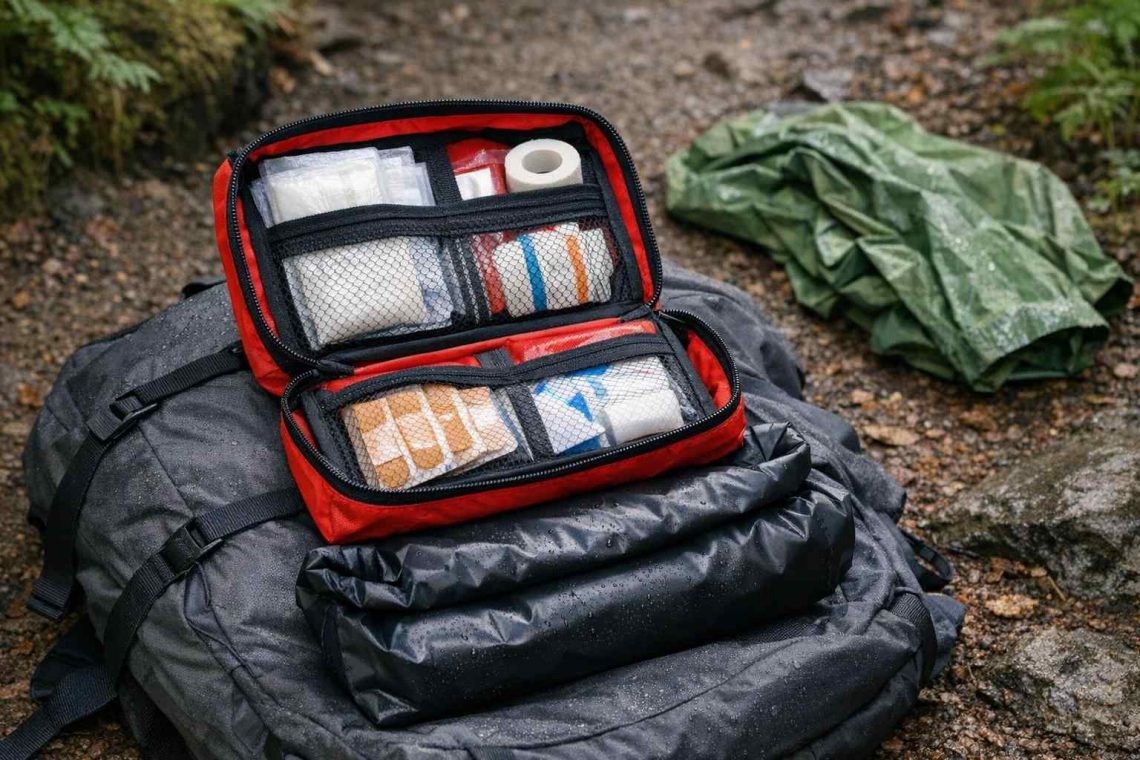
A waterproof first-aid kit is great but even the best closure can fail. A two-barrier approach is therefore simplest and best. Store your organized medical supplies in a waterproof pouch with a reliable closure and then put the pouch in a separate waterproof bag or roll-top container.
This inner pouch should be approximately the size of the contents and not so large that items can shift around and be crushed by other objects in the storage area. The outer layer can be a dedicated dry bag or a waterproof storage area such as a waterproof roll-top compartment or a protective pouch stored in a convenient location on the exterior of the pack.
While a hard cased kit is better to store small articles and prevents them from getting crushed by other items in your pack, the size of the case can become a problem. Often a hard case is too big to be stored in small spaces and can become a burden to carry. Soft cases, on the other hand, pack very well but require greater protection from sharp objects as well as pressure.
Keep the first aid kit where it is easily reached with wet hands
A small first-aid kit in a small truck can be out of the way in the back of the truck under various pieces of gear that need to come off before you can reach the first aid kit. In your pack a first aid kit should be in one of your accessible outside pockets or at the top of your pack in one of your consistently used pockets.
Before being incapacitated by an injury a person affected by it will typically be in a location and in a position that relates to the activity they were engaged in when the injury occurred. If you are going to need to treat minor wounds that are sustained while handling a pack, tools, etc. whilst carrying out camp tasks then it makes sense to store your first aid kit in proximity to where such injuries are likely to occur.
Keep medical items away from wet clothing, damp gloves, dirty tools, and opened food packages. Items to store apart from your medical supplies include clothes, tools, food, ammunition, knives, axes, etc. Try to store your supplies away from sharp blades and pointed objects to prevent accidental punctures to your supplies container.
Manage condensation after rain and temperature changes
However, water does not necessarily enter a first aid kit as rain. A cold pack can develop condensation in a warm car. Damp clothing can also develop in a pack and could soon penetrate a sealed pouch containing medical supplies. Inspect the contents of the first aid kit in the larger storage compartment after a wet day out. Spread out the supplies on a clean and dry surface and check for any signs of dampness or deterioration. Re-pack any items that have become contaminated, are damaged or no longer sealed.
First check the outside of the first aid kit for signs of moisture. Then, open up the outer pouch or container, and check the first aid supplies for signs of moisture. If any of the items have been contaminated with moisture in any way, they must be cleaned, replaced, or re-packaged. Do not use heat to dry out anything that has become wet as this can cause damage to packaging, clothing or even to some of the items themselves.
This check is particularly relevant when the contents of your first aid kit have been left to languish in the same pack that you take on your hikes, hunts and other work in the bush – and are used for work around camp too. Often these items are moved from one activity to another without being fully emptied or cleaned out.
Check seals, closures and packaging before leaving
Make sure to check all seals and closures for your first aid supplies before you leave. Press along the seal of any waterproof pouches, test the stitching of fabric pouches, check the plastic for any signs of cracking and test the closures of any bags to make sure they are gripping properly. A roll-top bag needs to have enough unoccupied material in order to form a proper closure. Don't overfill the bag or you will find that it appears to be closed, but water can get in.
The packaging of individual medicines must also be checked from time to time for signs of damage. In addition to being able to be closed and sealed, bandage wrappers must not be opened within the first aid kit and tube caps must be tightly closed. Small items such as bandages and plaster can be put into small, sealed sleeves. However, these should be grouped together in the first aid kit and not spread out all over the place in individual packages.
Before you set off, check that all personal medications and emergency contact details are up to date. Store items in accordance with the requirements for that item and refer to the packaging for use. Seek current official medical advice where required.
Match the protection to the day's exposure
A short day's walk in fine weather will require a very small (even sealed) pouch somewhere in your daypack. The same is true for most hunting with longer backpacks. But for long, wet and/or high-angled hunts with many stream crossings, or otherwise wet and "muddy" work such as long-distance trail maintenance or very wet canopy work, a very robust outer layer of protection with clear and specific intention to be at the front of the pack will be required even when the pack is sitting on very damp/saturated ground.
Remember that on a changeable day the first aid kit is best kept in a dry pocket of your pack before you start to add other clothing and food and then build up a layer of packaging around it for the journey home. On return to home take the time to remove the kit and check for any signs of moisture and restock with any items used.
Using a small first aid kit is important but does not end there. Your supplies, location and external protection all need to be suitable for the planned ground, weather and work. These simple habits help promote safe hiking.